A Private Label Fragrance Programme, Step by Step
A private label fragrance programme is a sequence of decisions, and the order matters more than the speed. Ranges that go smoothly are the ones where the price ladder, the pack format and the compliance route were fixed before sampling started. Ranges that go badly usually reverse those steps: they fall in love with a sample, then try to make the cost, the packaging and the paperwork fit around it.
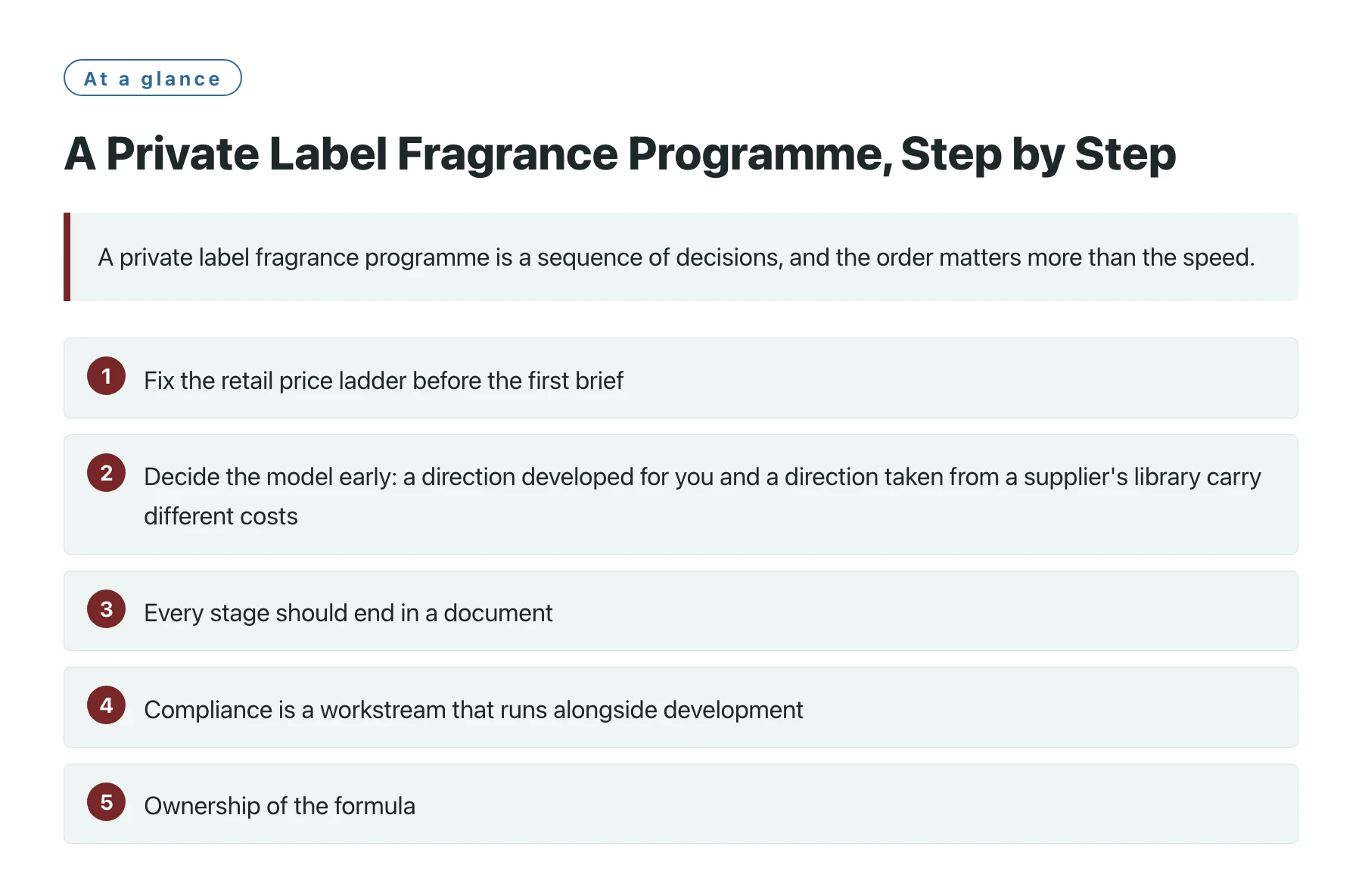
Key takeawaysFix the retail price ladder before the first brief, because it determines the dosage, the pack and the component quality you can afford. · Decide the model early: a direction developed for you and a direction taken from a supplier's library carry different costs, timelines and ownership terms. · Every stage should end in a document, whether that is an approved brief, a retained sample or a signed artwork proof. · Compliance is a workstream that runs alongside development, not a step at the end; labelling and product information requirements are easier to design into the pack than to add to it [1]. · Ownership of the formula, the mould and the design files should be settled while the relationship is still new [3].
Retailers enter private label for a predictable reason: the margin on someone else's brand is fixed, and the margin on their own is not. The manufacturing side of that decision, however, is a project with dependencies, and most of the risk sits in the handoffs rather than in any single step.
The sequence below is written for a retailer running its first or second own-brand fragrance programme. It assumes no factory of your own, a modest range, and a launch date that matters.
Treat each stage as a gate. A programme that passes a gate with a document is recoverable; one that passes on a verbal understanding generally is not.
Three decisions to make before the first meeting
The first is the price ladder: what the product will sell for, and therefore what it can cost to make. The second is the format: a single hero scent, a small family, or a travel and gift assortment. The third is the channel it will sit in, because a shelf in a pharmacy and a counter in a department store impose different packaging and documentation expectations.
These three decisions cost nothing to make and change almost everything downstream. A factory can work with any of the answers; it struggles when the answer changes halfway through sampling.
It also helps to look at how an established supplier presents its scope. A manufacturer that publishes its service range and certifications, such as XUELEI, is easier to plan against, because you can see which steps it owns and which it does not.
Write the price ladder down
Put the shelf price, the retailer margin and the maximum factory cost per unit on one line. Every later decision, from glass weight to carton board, gets checked against that line, which turns a series of preferences into a series of choices.
Choose the format before the scent
It sounds backwards, but the format constrains the brief. A 30 ml travel spray needs a different composition and a different opening than a 100 ml bottle meant to sit on a dressing table.
The programme in order
- 1. Define the range and the price ladderNumber of scents, sizes, price points and the maximum unit cost for each, written into one page.
- 2. Write the brief and the pack specScent direction, dosage, bottle, closure, decoration and carton, described in enough detail for two suppliers to quote the same thing.
- 3. Choose the development modelDecide whether the direction is developed for you or adapted from a library, and agree what exclusivity means in writing. A partner set up for one-stop fragrance manufacturing keeps development, filling and packing on one schedule, while a chain of specialists adds a handoff for every component.
- 4. Run the sample roundOne round with clear feedback beats four rounds of vague impressions; score each sample against the brief rather than against each other.
- 5. Confirm the compliance routeEstablish what the destination markets require for labelling, product information and safety assessment before artwork is finalised [1].
- 6. Approve a retained reference sampleA sealed physical sample with a date and a code, held by both sides, is the standard every later batch is judged against.
- 7. Release tooling and artworkOrder moulds, dies and print plates only after the reference is approved, and sign a physical proof before the print run.
- 8. Produce, inspect and releaseAgree the inspection points, the fill tolerance and the documents that must arrive with the goods before the final payment is released.
Where private label programmes actually slip
Three handoffs cause most of the delay. The first is between the approved sample and the bulk formula, where a supplier substitutes a material and the scent moves. The second is between the pack design and the print supplier, where a colour that looked right on screen is not achievable on the chosen substrate. The third is between the brand and the compliance work, where a labelling requirement is discovered after the cartons are printed.
None of these is exotic. Each is prevented by the same habit: make the next step depend on a signed document rather than on a recollection, and run private label fragrance production as a documented sequence rather than a series of favours.
Testing is a stage, not a formality
Stability and microbiological testing sit between sample approval and bulk release, and they take time that a launch calendar has to carry. A third-party testing scope typically covers the checks that tell you whether a formula and its packaging hold up together [2], and the results sometimes send a project back a step.
Settle ownership while everyone is friendly
Formula, mould and design files should be assigned in the contract. Industrial designs can be registered nationally or through the international route administered by WIPO, and registration only protects the brand if the brand, not the supplier, is the holder [3]. Asking about this in month one is a normal commercial question; asking in month twelve sounds like a dispute.
A useful discipline for a first programme is to keep a single project file with eight tabs, one per stage. If a stage cannot be closed because a document is missing, the project is not ready to move on, whatever the calendar says.
Sources
- European Commission: Cosmetics in the EU —— The European Commission's overview of EU cosmetics rules, including the responsible person, product information file and safety report requirements.
- SGS: Cosmetics, Personal Care & Household Testing —— Testing, inspection and certification services for cosmetics and personal care, including microbiological, stability and safety testing aligned with cosmetics GMP.
- WIPO — World Intellectual Property Organization —— The UN agency for intellectual property; resources on industrial design and patent protection relevant to product and packaging design.
Frequently asked questions
How long does a private label fragrance programme take?
It varies with the number of scents, whether the pack is stock or custom, and how quickly the brand gives feedback. The two steps most often underestimated are sample iteration and the compliance work needed for the destination market.
Do I need my own formula for a private label line?
No. Many programmes adapt a direction from a supplier's library. The trade-off is exclusivity, which is a commercial term you should agree before the sample is approved.
What is the minimum viable first range?
One or two scents in one size, with a pack that can be extended later. A narrow first range reduces tooling, artwork and inventory risk while proving the channel.
Who pays for tooling?
Usually the brand, because the brand keeps the asset. Confirm the position in writing, including what happens to the mould if the relationship ends or the product is discontinued.
When should the retailer involve a compliance specialist?
Before the artwork is signed off. Labelling, ingredient declaration and product information requirements differ by market, and changing a printed carton is far more expensive than adjusting a design.