RTA Shaker Cabinets on a Fixed Budget
A fixed budget does not fail at the door style. It fails at the tenth line item, when the sink base, the tall cabinet and the filler strips have all been added and the total is no longer the number in the spreadsheet. CasaBuilt's published prices make the trade-offs visible: the same six-cabinet kitchen costs $1,230.69 in Navy Blue and $2,295.64 in the oak-look line, so the finish alone can absorb more than a thousand dollars before a single drawer insert is chosen.
Key takeaways
- Price the cabinet list before the finish, because the finish is the largest single lever in a Shaker order.
- The gap between Navy Blue and the oak-look bundle is $1,064.94 at six cabinets.
- Published sale prices sit well under list on individual components, from $241.94 to $706.29 per line.
- Free shipping starts at $2,500, so a mid-sized order should be planned around that threshold.
Build the list before you look at finishes
A kitchen budget is a stack of decisions, and the order in which you make them decides how much room is left at the end. Start with the boxes: how many base cabinets, how many wall cabinets, whether there is a tall cabinet, and whether the room needs a vanity. That list is arithmetic, and it can be priced on any line in the catalog.
Only then choose the door. Buyers tend to do it the other way around, falling for a finish and then discovering that the layout they need does not fit the budget they have. The result is usually a compromise in the wrong place: a cheaper drawer box under an expensive door, or a run that stops two cabinets short of the corner.
There is a second reason to list the boxes first. Cabinet widths are published in fixed steps from 9 inches to 42 inches for bases and 9 inches to 39 inches for walls, so the list is constrained by the room rather than by taste. Once those widths are set, the only variable left is the finish, and a finish is easy to change.
Per-cabinet cost is the number to budget with
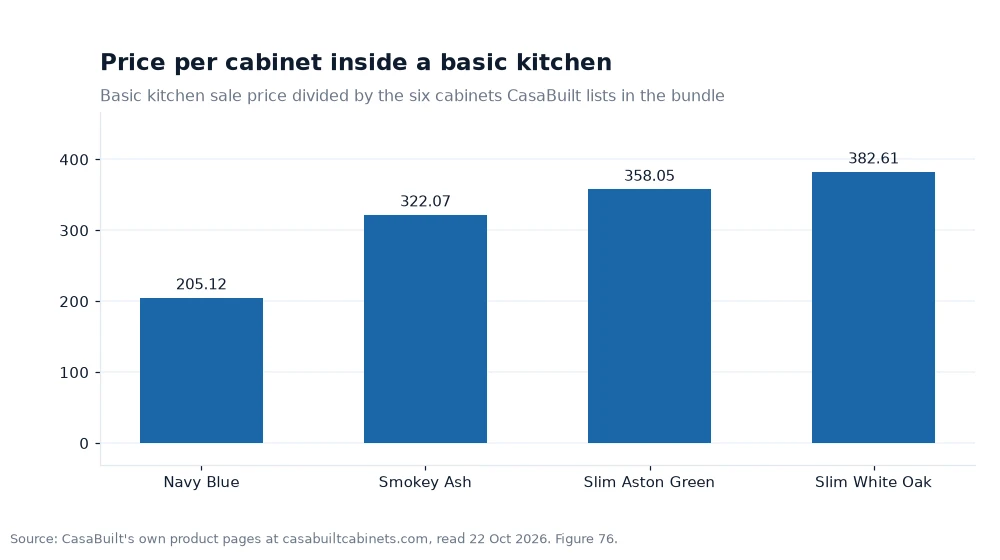
A bundle price is useful for comparison and useless for planning, because nobody builds a kitchen from exactly six cabinets. Divide the bundle by six and you get a unit cost you can multiply by a real cabinet count. Navy Blue works out at $205.12 per cabinet, Smokey Ash at $322.07, Slim Aston Green at $358.05 and the oak-look line at $382.61.
Those four figures span a factor of 1.87. That is the whole budget conversation in one number: the most expensive line costs 87 percent more per box than the cheapest, for a cabinet with the same box, the same hinges and the same drawer glides. The difference is the finish schedule and the narrow rail of the slim profiles.
Notice what does not change between the lines. The box is 1/2-inch birch plywood in every case, the face frame is 3/4-inch solid birch, the drawers are 5/8-inch rubberwood with dovetail joints and the shelves are 3/4-inch plywood. A buyer paying for the oak-look door is paying for the door, not for a better box.
Where the money leaves the budget
Individual components are where a budget either holds or slips. The published sale prices for the oak-look line show the size of the gap between sale and list on the pieces that a real kitchen needs, and the pattern is consistent across base cabinets, wall cabinets and tall units.
| Component | Sale price | List price | Saving |
|---|---|---|---|
| 30-42 in double-door, double-drawer base | $586.28 | $988.70 | $402.42 |
| Sink base, 30-36 in | $429.84 | $683.79 | $253.95 |
| 3-drawer base, 12-36 in | $471.46 | $1,041.95 | $570.49 |
| 30 in high double-door wall, 24-39 in | $347.76 | $750.01 | $402.25 |
| 42 in high double-door wall, 30-36 in | $437.41 | $899.81 | $462.40 |
| Oven cabinet, 33 in by 84 in | $906.16 | $1,612.45 | $706.29 |
| Vanity sink base, 24-30 in | $348.04 | $589.98 | $241.94 |
Add the seven sale prices and the sample list comes to $3,526.95 against a list total of $6,566.69, a difference of $3,039.74. That is not a discount a buyer negotiates; it is the published gap between the two numbers on the page. The practical lesson is that a budget built on list prices is roughly 86 percent higher than the same budget built on sale prices, which is why the sale column is the one to copy into a spreadsheet.
Saving inside the order, not around it
The first saving is width discipline. A 9-inch base cabinet costs $238.24 and a 30-42 inch double-door base costs $586.28, so a run made of narrow boxes is cheaper per inch of wall than a run made of wide boxes. Narrow boxes also give more usable storage per dollar in a small kitchen, because each one gets its own door and its own shelf. The trade-off is more doors to align and more stiles in the visual rhythm.
The second saving is skipping the specialty boxes until the layout demands them. A spice pullout at $322.92 and a waste-bin pullout at $503.04 are both good products, and neither is necessary to open a kitchen. A three-drawer base at $471.46 does more everyday work than either, and it costs less than the waste-bin unit.
The third saving is timing. CasaBuilt ships free at $2,500, and the RTA window is 3-10 business days with Alaska and Hawaii excluded. An order of $2,000 pays freight and an order of $2,500 does not, so adding $500 of drawer organizers or a second wall cabinet can cost less than the freight on the smaller order. The trade program offers 15-25 percent preferred pricing with no strict annual minimum for buyers who order repeatedly.
Layout help is free and worth taking before the list is final. The design-to-budget estimator lets a buyer test a cabinet list against a number before committing, and the free 3D design service returns a plan in 24-48 hours. For buyers weighing the flat-pack route against a finished box, the rta shaker cabinets collection lists every width with its sale and list price side by side.
Worked example: what the finish choice really costs
The chart gives four per-cabinet figures: Navy Blue at $205.12, Smokey Ash at $322.07, Slim Aston Green at $358.05 and Slim White Oak at $382.61. Multiply each by six to rebuild the bundle. Navy Blue gives $205.12 x 6 = $1,230.72, Smokey Ash gives $322.07 x 6 = $1,932.42, Slim Aston Green gives $358.05 x 6 = $2,148.30 and the oak-look line gives $382.61 x 6 = $2,295.66. The published bundle prices are $1,230.69, $1,932.42, $2,148.28 and $2,295.64, so the rounding costs at most three cents.
Now take the cheapest and the dearest. The per-cabinet gap is $382.61 - $205.12 = $177.49, and the bundle gap is $177.49 x 6 = $1,064.94. Divided by the $9.99 sample price, $1,064.94 / $9.99 = 106.6, so the difference would buy 106 sample doors. Spent on hardware instead, it covers the $906.16 oven cabinet and leaves $1,064.94 - $906.16 = $158.78.
That is the decision in one line: the oak-look finish, or a tall cabinet and a hundred-odd sample doors. Neither answer is wrong. What matters is that the choice is made with the numbers visible rather than discovered at checkout.
Frequently asked questions
Is a bundle cheaper than buying the cabinets one at a time?
The bundle is a comparison unit, not a discount mechanism. It prices a fixed set of two base cabinets, two wall cabinets, one tall cabinet and one vanity, and the per-cabinet figure quoted on a listing is simply that bundle divided by six. A buyer who needs a different mix should price the individual components, because the bundle says nothing about a kitchen with four drawers and no tall unit.
Should the extra money go to a finish or to more storage?
Storage usually earns its cost first. A three-drawer base at $471.46 changes how a kitchen works every day, while a finish change alters how it looks. Buyers who plan to sell within a few years tend to get more from the finish; buyers staying put tend to get more from the drawers.
Does the sale price apply to every component?
Every component checked on the oak-look line carries a sale price and a struck-through list price, and the discounts vary by item rather than sitting at a single flat percentage. That is why a list built on sale prices should be checked line by line instead of estimated with one discount rate.
Write the list, then write the number
Start with widths taken from the room, not from the catalog. Price those boxes on two finishes, add the freight threshold, and keep a line for the filler strips and the toe kick. Then decide whether the difference goes into the door or into the drawers.
A budget that survives contact with a real kitchen is one that was built from published prices in the first place. The alternative is a beautiful door on a run that stops short of the wall.
Figures quoted here come from the manufacturer's own website, read 22 Oct 2026[1].